
Prehung Door VS Slab Doors
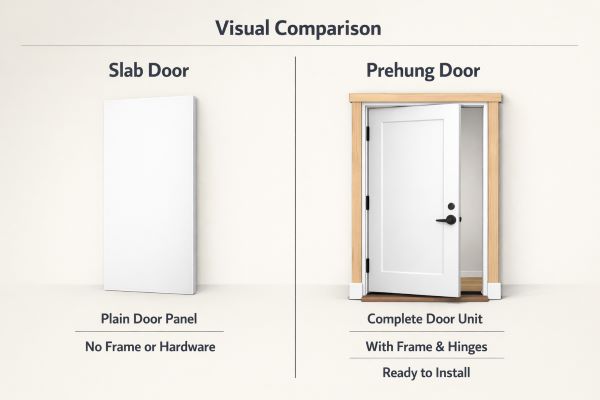
Buying a new door shouldn’t feel like a construction quiz. The biggest choice you’ll make upfront is whether you need a slab door (door only) or a prehung door (door already mounted in a frame). That decision affects price, installation difficulty, and the finished result.
30-second rule of thumb
- Choose a prehung door if it’s an exterior door, your current frame is damaged, or you want the cleanest, most reliable fit.
- Choose a slab door if your existing frame is in great shape and you want to swap the door with minimal disruption.
What is a Slab Door?
A slab door is the door panel by itself—no frame (jamb) and no hinges attached.
What it may include (varies by product)
- Sometimes holes for the knob/deadbolt are already drilled.
- It may be blank (no holes), or it may be hinge-prepped if ordered that way.
Why it can be tricky
To replace a slab successfully, the new door must match your existing setup:
- Hinge locations need to line up (or you’ll be cutting new hinge pockets).
- The door may need trimming to fit the opening evenly.
- Lock holes and backset must be compatible (or re-drilled correctly).
Best for
- Interior door replacements
- Exterior replacements only when the existing frame and threshold are in excellent condition
What is a Prehung Door?
A prehung door is a complete unit: the door is already attached to a new frame (jamb) with hinges installed.
What it typically includes
- Door, frame, and hinges
- For exterior doors: usually weatherstripping and a threshold/sill system (components vary by product)
Why it’s often the safer choice
- The door-to-frame alignment is factory set, so you’re starting from a consistent fit.
- You install the unit into the rough opening and adjust it with shims so it’s level, plumb, and square.
Best for
- Exterior doors
- New construction and remodels
- Any situation where the existing frame is warped, rotted, cracked, or out of square
Comparison at a Glance
| Feature | Slab Door | Prehung Door |
|---|---|---|
| What you get | Door only | Door + new frame + hinges (often exterior sealing components) |
| Upfront cost | Often lower | Often higher |
| Installation difficulty | Higher precision (fit door to existing frame) | More straightforward (fit unit to opening) |
| Impact on trim/finishes | Usually less disruption | Can require removing/replacing trim |
| Weather sealing (exterior) | Can be good, but harder to achieve consistently | Typically easier to get a tight seal |
Before You Decide: 5 Quick Checks
- Is your current frame solid and square? If it’s damaged or out of square, prehung is usually smarter.
- Is this an exterior door? If sealing or the threshold is questionable, prehung is often the better choice.
- Do you know your swing/handing? Left-hand vs. right-hand and inswing vs. outswing matter.
- Can you match hinge locations and door thickness? If not, a slab replacement usually needs more carpentry work.
- Do you want to keep existing trim? Slabs are often chosen to avoid disturbing casing and finishes.
Which One Should You Buy?
Choose a Slab Door if
- Your existing frame is in excellent condition (no rot/warp, door closes cleanly).
- You want a replacement with minimal trim work.
- You’re comfortable ensuring hinge placement, sizing, and lock prep are correct (or your installer is).
Choose a Prehung Door if
- It’s an exterior entry door and you want the most reliable path to a tight seal.
- Your current frame is damaged, soft, cracked, or out of square.
- You’re remodeling or want a fresh start (new frame, consistent clearances, cleaner finished result).
- You want to reduce common issues like sticking, uneven gaps, or latching problems (installation still matters, but you’re starting from a better baseline).
If you’re unsure, start by checking your frame condition and swing direction—those two details usually make the decision for you.